![[e]Photo Stream](/logo.png)

August 24
5 moments across history
Pluto Reclassified as a Dwarf Planet
On August 24, 2006, the International Astronomical Union adopted a formal planet definition that reclassified Pluto as a dwarf planet. The decision reduced the Solar System’s recognized planets from nine to eight and clarified that a planet must clear its orbital neighborhood. Discovered in 1930, Pluto had long been called the ninth planet, but discoveries of similar outer Solar System objects prompted the new classification.
Pluto Reclassified as a Dwarf Planet
Ukraine Declares Independence

Ukraine Declares Independence

Year: 1991
On August 24, 1991, Ukraine’s parliament adopted the Act of Declaration of Independence, proclaiming Ukraine an independent state. The decision mattered because it ended Soviet rule in Ukraine and was overwhelmingly endorsed by voters in a December 1991 referendum. It came amid the Soviet Union’s collapse after a failed coup in Moscow, helping accelerate the USSR’s formal dissolution later that year.
Mazowiecki Becomes Poland’s Prime Minister

Mazowiecki Becomes Poland’s Prime Minister

Year: 1989
On August 24, 1989, Poland’s parliament approved Solidarity adviser Tadeusz Mazowiecki as prime minister. He became the first non-Communist head of government in Eastern Europe in more than four decades, weakening Communist Party rule. His appointment followed Solidarity’s election victory and marked a pivotal step in the collapse of Soviet-backed regimes across the region.
France Tests Its First Hydrogen Bomb

Event 4

Year: 1968
On August 24, 1968, France detonated Canopus, its first thermonuclear weapon, over Fangataufa Atoll in French Polynesia. The test made France the fifth country to demonstrate hydrogen-bomb capability, after the United States, Soviet Union, United Kingdom, and China. It formed part of France’s independent nuclear deterrent program amid the Cold War arms race and growing concern over atmospheric nuclear testing.
NATO Treaty Takes Effect
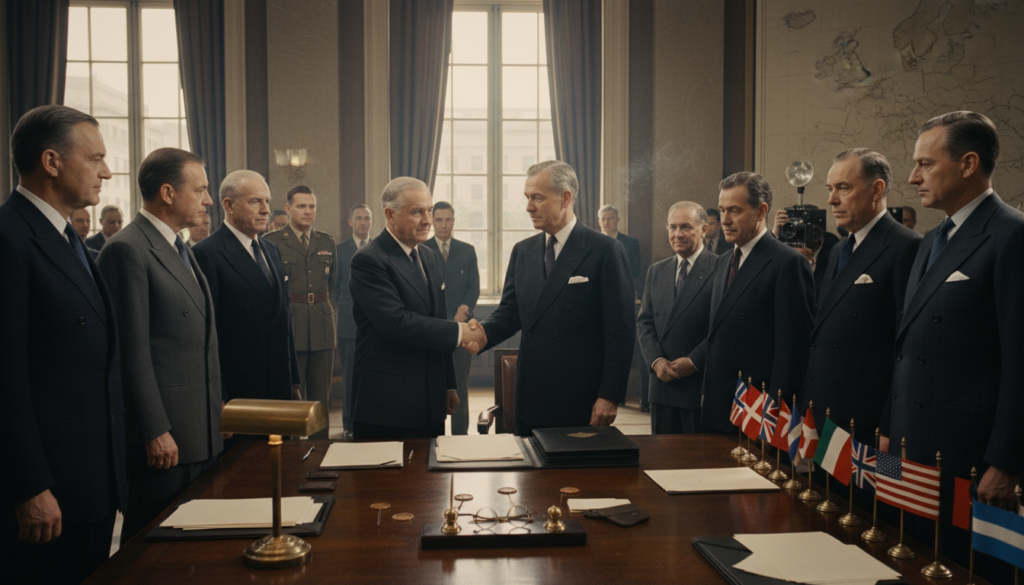
NATO Treaty Takes Effect

Year: 1949
On August 24, 1949, the North Atlantic Treaty entered into force after being signed by 12 founding members. It created NATO, a collective-defense alliance whose members agreed that an attack on one would be considered an attack on all. Its formation reflected rising Cold War tensions and Western efforts to deter Soviet expansion and protect Europe and North America.