![[e]Photo Stream](/logo.png)

April 4
5 moments across history
Assassination of Martin Luther King Jr.
On April 4, 1968, civil rights leader Dr. Martin Luther King Jr. was shot and killed on the second-floor balcony of the Lorraine Motel in Memphis, Tennessee, where he had traveled to support striking sanitation workers. The assassination by James Earl Ray sent shockwaves through America and the world, triggering riots in over 100 cities. King had been the moral conscience of the civil rights movement, winning the Nobel Peace Prize in 1964 for his nonviolent campaign against racial inequality. His death marked the end of an era — and the beginning of a long reckoning with the violence of American racism.
The Lorraine Motel balcony where Dr. King fell — a site that would become a national civil rights landmark.
NATO Founded — Twelve Nations Sign the North Atlantic Treaty
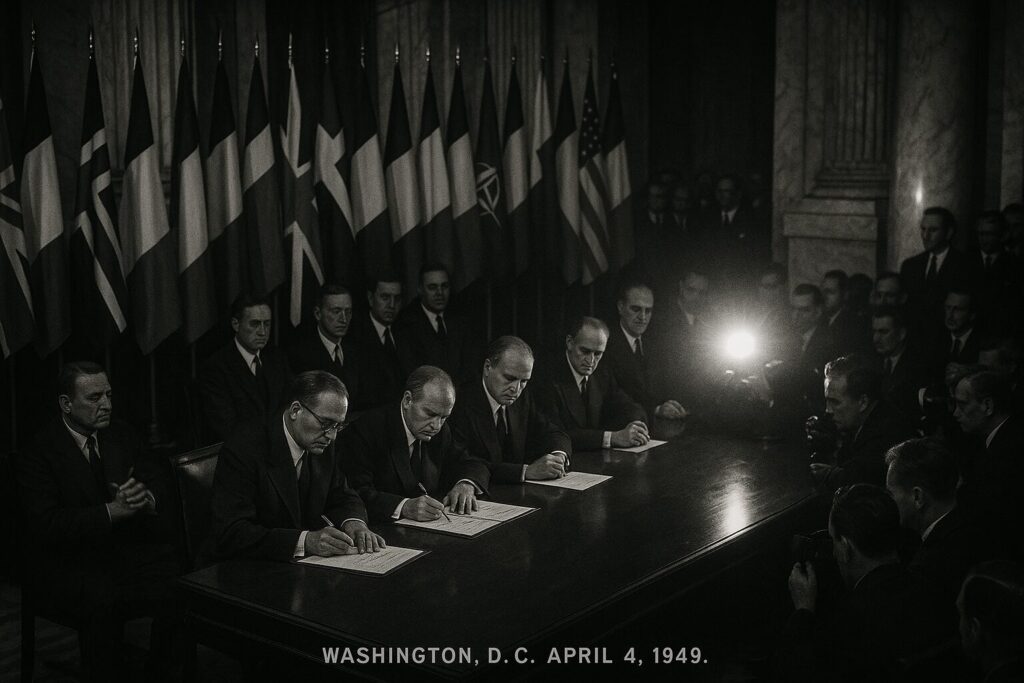
Twelve foreign ministers sign the North Atlantic Treaty in Washington D.C., April 4, 1949 — a pact that would define the Cold War.

War-room maps of a fractured Europe — the strategic calculus behind NATO's founding in the face of Soviet pressure.
On April 4, 1949, representatives of twelve nations gathered in Washington D.C. to sign the North Atlantic Treaty, creating the most powerful military alliance in history. Formed in the shadow of Soviet expansionism and the Berlin Blockade, NATO bound the United States, Canada, and ten Western European nations to a principle of collective defense: an attack on one was an attack on all. The treaty fundamentally reshaped the postwar world order, drawing a hard line across a divided Europe and committing American power to the continent's security for generations to come.
Bill Gates and Paul Allen Found Microsoft

A modest Albuquerque office, 1975 — the birthplace of the company that would put software at the center of the modern world.

Early personal computers and their blinking green screens: the hardware frontier that Microsoft's software would come to dominate.
On April 4, 1975, childhood friends Bill Gates and Paul Allen formally incorporated Microsoft in Albuquerque, New Mexico, with a singular vision: a computer on every desk and in every home. The company had begun months earlier when they wrote a BASIC interpreter for the Altair 8800 microcomputer. What started in a small office would grow into the most valuable software company in the world, redefining how humanity works, communicates, and thinks. Gates and Allen's bet on the personal computing revolution proved to be among the most consequential business decisions of the 20th century.
Space Shuttle Challenger's Maiden Voyage

Space Shuttle Challenger rises from Kennedy Space Center on STS-6, April 4, 1983 — the beginning of a storied and tragic history.

Mission control monitors every telemetry feed as Challenger climbs into orbit on its maiden voyage.
On April 4, 1983, the Space Shuttle Challenger lifted off from Kennedy Space Center on its first mission, STS-6. The flight lasted five days and marked a new chapter for NASA's shuttle program, which had been launched two years earlier with Columbia. Challenger would go on to fly nine missions before its tragic destruction on January 28, 1986. But on this April morning, it rose into an uncertain dawn as a symbol of American ambition — sleek, reusable, and pointed toward the stars. The crew conducted the first spacewalk of the shuttle era during the mission.
Napoleon Bonaparte Signs His First Abdication

Napoleon signs his abdication by candlelight at Fontainebleau — a man of empires reduced to a signature on a page.

The Imperial Guard stands in silent formation outside Fontainebleau, their eagles lowered as an empire ends in gray silence.
On April 4, 1814, Napoleon Bonaparte signed a conditional abdication at Fontainebleau, naming his young son Napoleon II as his successor after two decades of war had exhausted France and its emperor. Allied forces had entered Paris, his marshals had refused to march, and the empire built on conquest had finally collapsed under its own weight. Within days, Napoleon would sign an unconditional abdication and begin his exile to Elba — though his story was far from over. The fall of Napoleon marked the end of a revolutionary era and the beginning of the long European effort to restore the old order.